AI & Data Security & Compliance
Understand Your AI Risk Before It Becomes a Breach.
AI and data security addresses the risk that arrives with AI adoption. Blue Mantis assesses AI risk and readiness, develops the governance framework, secures the data that Copilot and other AI tools reach into, aligns the program to regulatory requirements, and monitors risk on an ongoing basis.
-
AI risk and exposure visibility -
Data-first security controls -
Governance aligned to frameworks -
Continuous AI risk oversight
What Blue Mantis Delivers in AI and Data Security and Compliance
Blue Mantis helps organizations assess AI risk, establish governance, secure data, and maintain ongoing oversight as AI adoption grows.
AI Risk & Readiness Assessment
Blue Mantis evaluates how AI is being used across your organization and identifies risk across identity, data, access, and model behavior. We provide a clear starting point for safe AI adoption.
What Blue Mantis covers
- AI use case discovery process: Identifies Copilot, private GPTs, and embedded AI usage.
- Risk exposure analysis across domains: Evaluates identity, data, and access vulnerabilities.
- Governance and policy readiness review: Assesses existing controls and oversight gaps.
- Prioritized remediation roadmap: Defines next steps to reduce risk and improve readiness.
Covers
AI RiskAI ReadinessCopilotRisk AssessmentAI Exposure
AI Governance Framework Development
Blue Mantis helps organizations establish an AI Governance Office, the structure, charter, and operating model that ensures AI adoption happens within defined, enforceable boundaries instead of unmanaged risk.
What Blue Mantis covers
- AI Governance Office establishment: Builds the team, charter, and decision rights needed to oversee AI adoption.
- AI acceptable use policy: Defines clear rules for how AI tools can and cannot be used across the organization.
- NIST AI RMF alignment: Aligns AI risk management to the NIST AI Risk Management Framework.
- Legal and cross-functional engagement: Brings legal and business stakeholders into a cadence-driven governance operating model.
Covers
AI GovernanceNIST AI RMFAI PolicyGovernance Office
Data Security for AI & Copilot
Blue Mantis focuses on protecting the data that powers AI systems, extending data loss prevention to prompts, agent outputs, and browser-based LLM usage, not just traditional file and email channels.
What Blue Mantis covers
- Sensitive data discovery and classification: Identifies PII, PHI, financial data, and intellectual property.
- DLP for AI channels: Extends Microsoft Purview data loss prevention to AI prompts, agent outputs, and browser-based LLM usage.
- Access control and data governance enforcement: Applies role-based access and least privilege principles.
- Guardrails for AI data usage: Prevents unintended sharing or misuse of critical data through AI tools.
Covers
Microsoft PurviewDLPCopilot RiskData Governance
AI Compliance & Regulatory Alignment
Blue Mantis ensures AI usage aligns with regulatory requirements and emerging standards. We reduce compliance risk while enabling responsible AI adoption.
What Blue Mantis covers
- Regulatory mapping for AI systems: Aligns usage to frameworks such as NIST AI RMF, SOC 2, HIPAA, and EU AI Act.
- Compliance gap identification: Highlights areas where AI usage introduces risk or non-alignment.
- Audit readiness and documentation: Prepares supporting evidence for regulatory review.
- Alignment with existing GRC programs: Integrates AI compliance into broader governance operations.
Covers
AI ComplianceRegulatoryNIST AI RMFEU AI ActAudit Readiness
AI Monitoring & Risk Oversight
Blue Mantis provides continuous oversight of AI systems, ensuring risk is detected early and controls remain effective as AI usage grows.
What Blue Mantis covers
- AI usage and behavior monitoring: Tracks access patterns and anomalies across AI workflows.
- Data exposure tracking and analysis: Identifies potential misuse or leakage scenarios.
- Model and output risk monitoring: Detects drift and unexpected behavior in AI systems.
- Continuous risk reporting and visibility: Provides executive oversight as AI environments scale.
Covers
AI MonitoringRisk OversightBehavioral AnalysisContinuous MonitoringAI Risk
What happens at each step
How AI & Data Security and Governance Works
Step 1
Discover AI Usage Across the Organization
We uncover how AI is being used across your organization, including Copilot, private GPTs, and embedded AI tools. This establishes a clear baseline of where risk exists.
Step 2
Assess Data and Governance Gaps
AI systems are evaluated across identity, data, access, and model behavior. This identifies gaps in data protection, governance structure, and oversight that increase exposure.
Step 3
Design Controls and Frameworks
Governance frameworks, data security controls, and access policies are designed and implemented to align AI usage with business risk and compliance requirements. This ensures AI adoption is structured, not ad hoc.
Step 4
Monitor, Report, and Continuously Improve
Ongoing monitoring tracks AI behavior, data exposure, and compliance alignment. This keeps controls effective as AI usage grows and requirements evolve.
Frequently Asked Questions
What are the security risks of deploying Microsoft Copilot?
The main risks are unintended data exposure and misuse. Copilot depends on the data it can reach, so gaps in identity, permissions, and classification can surface sensitive information such as PII, PHI, financial data, or intellectual property. Blue Mantis addresses this with sensitive data discovery and classification, role-based access and least privilege, and Microsoft Purview data loss prevention extended to AI prompts, agent outputs, and browser-based LLM usage.
How do you govern AI use across an organization?
Blue Mantis helps establish an AI Governance Office with the team, charter, and decision rights needed to oversee AI adoption. An acceptable use policy defines how AI tools can and cannot be used, and AI risk management is aligned to the NIST AI Risk Management Framework. Legal and business stakeholders join a cadence-driven governance operating model so adoption stays within defined boundaries.
What regulations apply to AI systems today?
It depends on the industry and the data involved. Blue Mantis maps AI usage to frameworks and requirements such as the NIST AI Risk Management Framework, SOC 2, HIPAA, and the EU AI Act, then identifies where AI usage introduces compliance gaps. The work also covers audit readiness documentation and integrates AI compliance into existing GRC programs.
Why is AI risk different from traditional security risk?
AI introduces new attack surfaces tied to data access, model behavior, and automation. Risks include unintended data exposure, misuse, and decision-making impacts that traditional controls are not designed to address. Blue Mantis evaluates these risks across identity, data, access, and model behavior, then designs the controls and monitoring that match what it finds.
How often should AI risk be reassessed?
AI risk should be continuously monitored and periodically reassessed as new use cases, models, and integrations are introduced. AI environments evolve quickly, and controls must keep pace. Blue Mantis tracks AI usage and behavior, data exposure, and model output over time, and reports on risk so oversight continues as adoption grows.
Understand where AI creates risk in your organization.
We will identify where AI is being used, what data it touches, and where governance and controls may be missing. You leave with a clear roadmap to reduce risk and move forward with confidence.

Related Resources
Datasheet
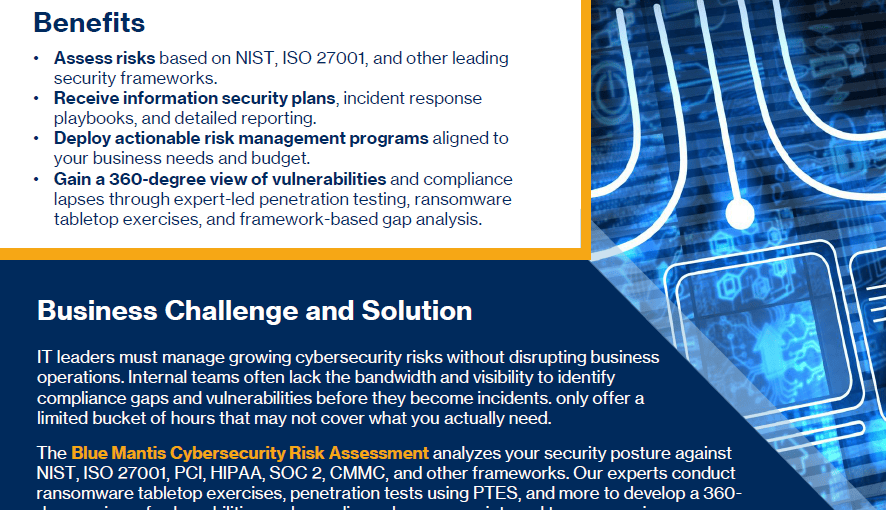
Hybrid workforces, cloud environments, and mobile devices create an expanding attack surface that internal teams struggle to monitor objectively. Reactive security is no longer enough.

Blog
This is not alarmism. It is a description of a gap that is now quantifiable, sourced, and closing in the wrong direction.