Governance, Risk and Compliance (GRC)
Turn Risk and Compliance Into a Managed Program.
Governance, risk and compliance turns a periodic audit scramble into a managed program. Blue Mantis runs risk management, vendor and third-party management, asset management and CMMC rapid deployment on an ongoing basis, so evidence is current when an auditor, customer or insurer asks for it.
-
Continuous compliance without fire drills -
Risk tied to business impact -
Executive level visibility and reporting -
Unified governance across the organization
What Blue Mantis Delivers in Governance, Risk and Compliance
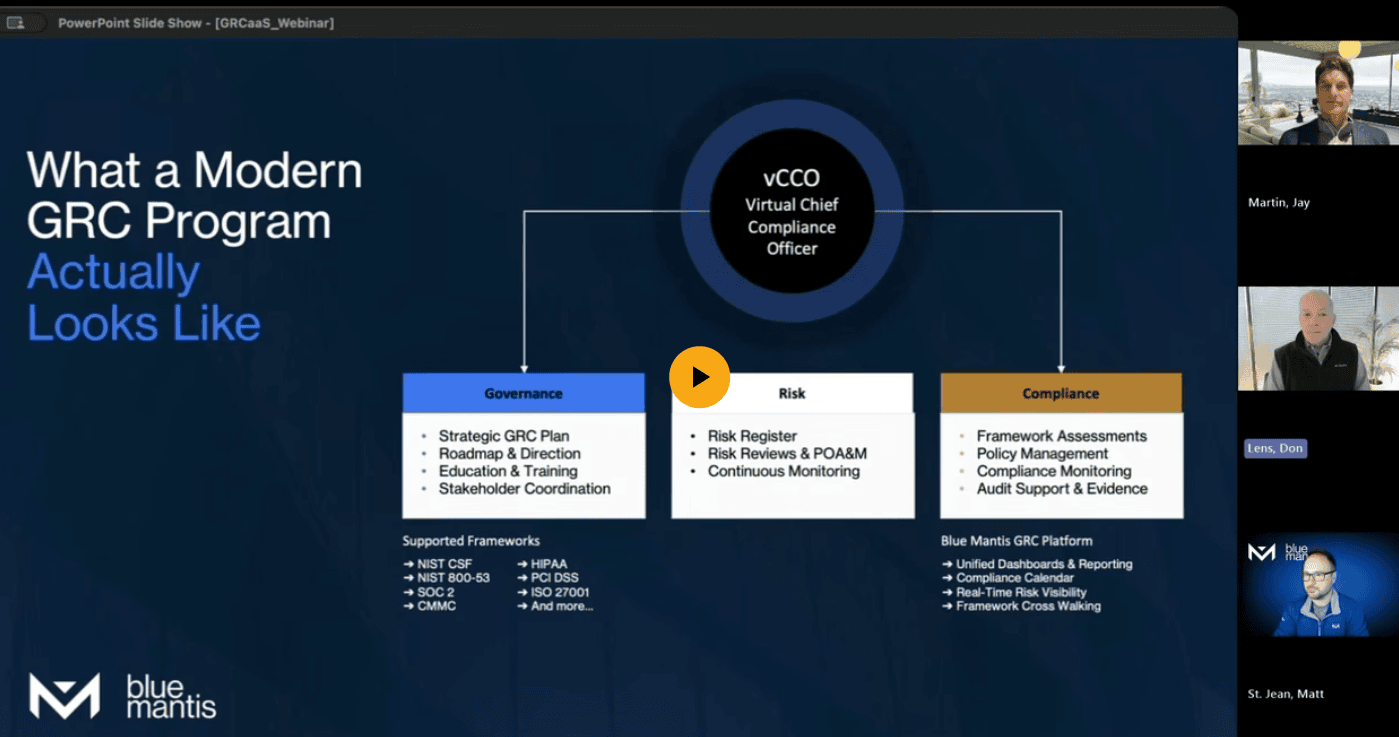
Blue Mantis provides the operational pillars of a modern GRC program, ensuring risk is identified, managed, and governed consistently.
Risk Management
Risk management ensures that exposure is identified, measured, and acted on continuously, aligned to the frameworks that matter to your business and your customers, including NIST, PCI, HIPAA, SOC 2, CMMC, GDPR, and ISO 27001.
What Blue Mantis covers
- Cybersecurity risk assessment: Evaluates exposure and aligns findings to recognized frameworks including ISO 27001.
- Risk register creation and maintenance: Track and update risks across the organization.
- Risk scoring and heat mapping: Prioritize based on business impact and likelihood.
- Multi-framework compliance support: Including CMMC, GDPR, NIST, PCI, HIPAA, and SOC 2.
Covers
CMMCGDPRISO 27001Risk Assessment
Vendor Management
Vendors introduce risk that is outside direct control but still impacts your business. This service ensures third party relationships are evaluated, monitored, and governed as part of your overall risk program.
What Blue Mantis covers
- Vendor risk assessments and tiering: Evaluate vendors based on exposure and impact.
- Ongoing monitoring of vendor posture: Track changes in risk over time.
- Security and compliance review processes: Validate vendor controls and obligations.
- Audit ready documentation maintained: Provide defensible evidence for regulators.
Covers
Vendor RiskThird PartySupply ChainComplianceAssessment
Asset Management
You cannot manage risk or compliance without knowing what assets exist and how they are governed. This service ensures systems, data, and resources are tracked, classified, and controlled consistently.
What Blue Mantis covers
- Asset inventory and classification: Maintain visibility into systems and data assets.
- Ownership and accountability mapping: Define who is responsible for each asset.
- Lifecycle and change tracking: Ensure assets remain governed over time.
- Integration with risk and compliance programs: Align assets to controls and policies.
Covers
Asset ManagementInventoryClassificationGovernanceOwnership
CMMC Rapid Deployment
Accelerate your path to CMMC compliance with a structured approach that combines assessment, remediation, secure enclave design and audit readiness support. Built to help organizations protect CUI and prepare for CMMC Level 2 requirements.
What Blue Mantis covers
- CMMC readiness assessment: Establishes where you stand against CMMC Level 2 practices and what evidence already exists.
- Gap analysis and remediation planning: Turns assessment findings into a sequenced plan with owners, effort and dependencies.
- GCC High and secure enclave deployment: Stands up the boundary that keeps CUI in scope and the rest of the environment out of it.
- Policy and control development: Produces the policies, procedures and system security plan an assessor will ask for.
- Audit preparation and evidence collection: Assembles the evidence package and runs the readiness review before the C3PAO does.
Covers
CMMC Level 2CUI ProtectionGCC HighSecure EnclavesAudit Readiness
What happens at each step
How We Run Your GRC Program
Step 1
Identify Risk and Obligations
We identify regulatory, contractual, and internal obligations alongside the risks that threaten them. This establishes a clear baseline for governance and compliance.
Step 2
Establish Governance Model
We define roles, ownership, policies, and decision frameworks. This ensures accountability is clear and enforceable across the organization.
Step 3
Operationalize Controls and Programs
Risk, compliance, and governance processes are translated into repeatable workflows. This ensures execution is consistent rather than reactive.
Step 4
Monitor, Report, and Improve
Programs are continuously monitored, measured, and refined through reporting and review cycles. This ensures alignment as risk and regulatory requirements evolve.
Managed Cybersecurity Services
Mantis Protect Is How Blue Mantis Delivers Managed Cybersecurity
Managed cybersecurity services cover the work most teams cannot staff around the clock: continuous monitoring, threat detection, investigation and response. Without that coverage, even well-chosen tools leave gaps that surface at the worst possible moment.
Mantis Protect is the Blue Mantis managed cybersecurity program. It brings 24×7 monitoring, detection and response together with the compliance and testing work that surrounds it, so one team is accountable for the outcome instead of a set of disconnected tools.
24×7 MonitoringThreat DetectionIncident ResponseManaged SIEMThreat HuntingExposure ManagementSecurity ExpertsCompliance SupportSecurity Operations
| Common Challenges | How Mantis Protect Helps |
|---|---|
| Limited visibility into threats across your environment | ✓Continuous monitoring and threat detection |
| Security alerts overwhelming internal teams | ✓Expert triage and investigation support |
| Difficulty responding to incidents quickly | ✓24×7 response guidance and escalation |
| Lack of round-the-clock security coverage | ✓Always-on protection from a dedicated security team |
| Keeping up with evolving compliance requirements and audit demands | ✓Continuous GRC expertise without adding headcount |
Frequently Asked Questions
What does a GRC program include?
A GRC program includes risk management, vendor management, and asset management run as ongoing functions rather than periodic projects. Blue Mantis identifies regulatory, contractual, and internal obligations, defines roles, ownership, and policies, translates controls into repeatable workflows, and monitors and reports on the program over time. Risk registers, scoring, and heat mapping keep exposure visible and prioritized.
How do you manage third-party and vendor risk?
Blue Mantis manages third-party and vendor risk through assessments and tiering that rank vendors by exposure and impact. Vendor posture is monitored on an ongoing basis so changes in risk are tracked over time. Security and compliance reviews validate vendor controls and obligations, and audit ready documentation is maintained so you can provide defensible evidence to regulators.
What is the difference between compliance and governance?
Compliance is meeting the obligations that apply to your business, and governance is the structure that decides who owns those obligations and how they are met. Blue Mantis defines roles, ownership, policies, and decision frameworks, then operationalizes risk and compliance processes into repeatable workflows. Governance is what keeps controls consistent between audits instead of letting them drift.
Why do GRC programs break down over time?
Most programs fail because ownership is unclear and processes are not operationalized. Policies exist, but risk is not tracked consistently and controls drift between audits. Without continuous monitoring and reporting, visibility breaks down and exposure increases. Blue Mantis addresses this by assigning ownership and running monitoring, reporting, and review cycles on a continuous basis.
What outcomes should we expect from this service?
You should expect clear ownership, consistent risk visibility, and structured reporting. Over time, this reduces audit disruption, improves decision making, and strengthens overall security posture. The goal is to make governance repeatable, measurable, and aligned to the business. Programs are refined through regular review cycles as risk and regulatory requirements change.
Get Control of Risk Across Your Organization
We help you establish a structured GRC program with clear ownership, visibility, and accountability. Start with a conversation about your current gaps and where risk is building.
Related Resources
Datasheet
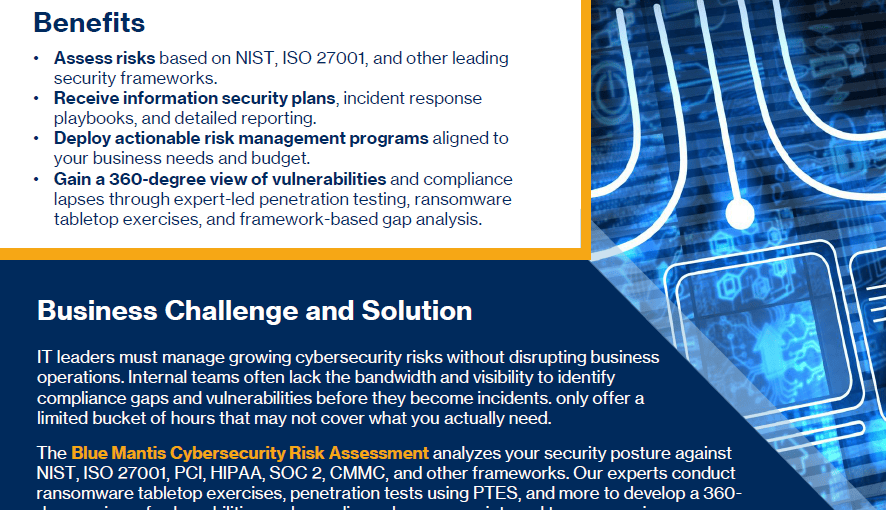
Hybrid workforces, cloud environments, and mobile devices create an expanding attack surface that internal teams struggle to monitor objectively. Reactive security is no longer enough.
Blog
This is not alarmism. It is a description of a gap that is now quantifiable, sourced, and closing in the wrong direction.