
Offensive Security: Penetration Testing and Red Teaming
Identify How Attackers Would Break in, Before They Do.
Offensive security finds how an attacker would break in, before one does. Blue Mantis runs penetration testing across networks and applications, social engineering and deepfake simulations, web, mobile and API testing, targeted testing of cloud and identity systems, and red teaming against AI models and their guardrails.
-
Real-world attack simulation -
Identity and access focus -
Business-impact driven findings -
Prioritized remediation guidance
What Blue Mantis Delivers in Offensive Security
Blue Mantis delivers offensive security testing spanning infrastructure, applications, identity, people, and emerging AI-driven threats.
Penetration Testing
Blue Mantis simulates real-world attacks against internal and external environments, including wireless and physical access points, to identify exploitable vulnerabilities. Testing follows the Penetration Testing Execution Standard (PTES), an industry-recognized methodology that validates how attackers could gain access, escalate privileges, and move across systems.
What Blue Mantis covers
- Internal and external attack simulation: Tests how attackers would access systems from outside and inside your network.
- Red and purple team operations: Combines adversary simulation with defensive visibility to improve detection and response.
- Wireless and physical testing: Evaluates rogue access points, interception, segmentation gaps, and unauthorized facility entry.
- PTES-aligned methodology: Industry-standard testing approach with risk-based prioritization on findings.
Covers
Pen TestingPTESRed TeamPurple Team
Social Engineering & Deepfake
Blue Mantis tests how attackers exploit trust, behavior, and identity using phishing, impersonation, and AI-driven deepfake techniques. We focus on human risk, where traditional controls are least effective.
What Blue Mantis covers
- Simulated human-targeted attacks: Tests phishing, vishing, impersonation, and social engineering pathways.
- Deepfake attack scenario testing: Evaluates exposure to voice cloning, executive impersonation, and identity spoofing.
- Response readiness validation: Measures how teams detect and respond to suspicious activity.
- Targeted awareness improvement: Strengthens employee recognition and reporting of manipulation attempts.
Covers
Social EngineeringDeepfake TestingPhishingVishingHuman Risk
Web, Mobile & API Testing
Blue Mantis identifies vulnerabilities in web applications, mobile apps, and APIs by simulating real attack techniques. We focus on how attackers interact with applications and the business impact of exploitation.
What Blue Mantis covers
- Application-layer attack simulation: Tests vulnerabilities across authentication, authorization, and data handling.
- API and integration assessment: Identifies weaknesses across connected systems and services.
- Mobile application testing: Evaluates risks in iOS and Android apps and their backend connections.
- Secure development gap analysis: Highlights risks in coding, configuration, and deployment practices.
- Business-impact validation: Connects technical flaws to real-world data exposure or system compromise.
Covers
Web App TestingMobile TestingAPI SecurityBusiness LogicApplication Risk
Cloud, AI & Identity Testing
Blue Mantis tests how attackers exploit modern cloud environments, AI-driven systems, and identity infrastructure. We focus on attack paths across permissions, credentials, and integrated workflows that lead to real business impact.
What Blue Mantis covers
- Cloud attack path simulation: Identifies risks across identity, permissions, and service configurations.
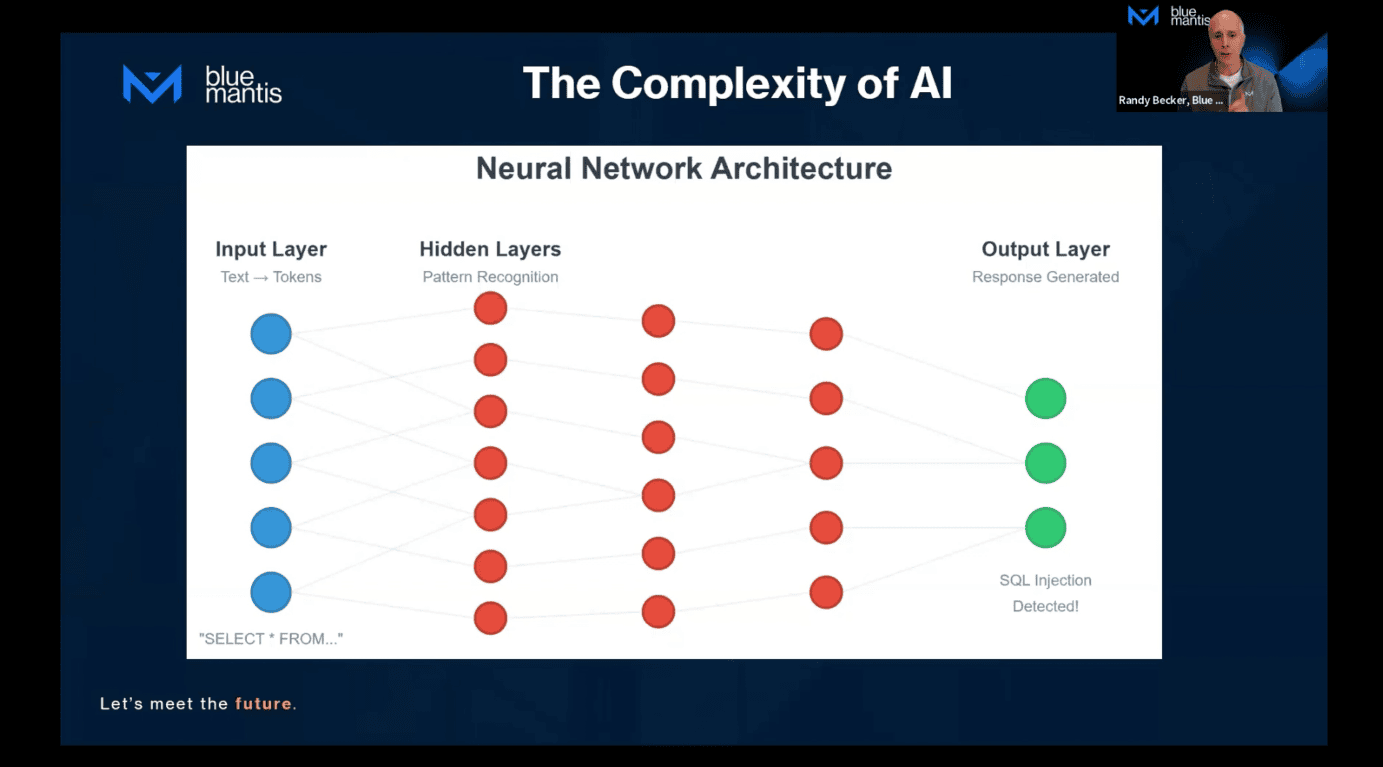
- AI system behavior testing: Evaluates prompt injection, data leakage, and misuse scenarios.
- Active Directory risk assessment: Identifies misconfigurations, trust weaknesses, and excessive privileges.
- Privilege escalation testing: Simulates how attackers gain elevated access across environments.
- Identity attack path mapping: Shows how an attacker could move from initial access to domain control.
- End-to-end attack mapping: Shows how initial access leads to business impact across cloud and AI systems.
Covers
Cloud Red TeamAI Red TeamingActive DirectoryIdentity RiskPrivilege Escalation
AI Red Teaming
Identify vulnerabilities, test AI safeguards, and evaluate how your AI systems respond to adversarial prompts, misuse and data exposure risks.
What Blue Mantis covers
- Adversarial prompt testing: Probes the model with prompt injection and jailbreak techniques to see what gets through.
- AI model security assessment: Reviews the model, its integrations and the infrastructure behind it for exploitable weaknesses.
- Data leakage and abuse testing: Checks whether training data, system prompts or connected records can be pulled back out.
- Guardrail validation: Confirms the safety and policy controls hold under deliberate pressure, not just normal use.
- Risk findings and remediation guidance: Reports what failed, what it would take an attacker to reach it, and what to fix first.
Covers
Generative AILLM SecurityPrompt InjectionData LeakageAI Governance
What happens at each step
How Offensive Security Testing Works
Step 1
Define Attack Scope
We align testing to your environment, business priorities, and risk profile. This ensures scenarios reflect how attackers would realistically target your organization.
Step 2
Simulate Real Attacks
Offensive testing replicates real-world adversary techniques across network, identity, applications, and users. This exposes vulnerabilities that automated scans and controls often miss.
Step 3
Validate Impact and Exposure
Findings are validated through real attack paths, showing how vulnerabilities could lead to data exposure, privilege escalation, or operational disruption. This connects technical gaps to business risk.
Step 4
Deliver Actionable Remediation
Receive prioritized recommendations and a clear roadmap to close exposure gaps. This ensures teams focus on the vulnerabilities that matter most, not just the most visible.
Frequently Asked Questions
How often should we run a penetration test?
Most organizations run a penetration test annually, and again after major changes such as new applications, infrastructure updates, or cloud migrations. Regular testing means new vulnerabilities and attack paths are identified before they are exploited. Blue Mantis scopes each engagement to your environment, business priorities, and risk profile, so scenarios reflect how attackers would realistically target your organization.
What is the difference between a vulnerability scan and a penetration test?
A vulnerability scan identifies known issues, and a penetration test validates how those issues can actually be exploited. Scans do not show how findings chain together. Blue Mantis penetration testing simulates real attacks using the Penetration Testing Execution Standard, showing how an attacker could gain access, escalate privileges, and move across systems, and what the business impact would be.
What is a deepfake social engineering simulation?
A deepfake social engineering simulation tests how your people respond to AI-driven impersonation. Blue Mantis evaluates exposure to voice cloning, executive impersonation, and identity spoofing, alongside phishing, vishing, and other social engineering pathways. The exercise measures how teams detect and respond to suspicious activity, and it strengthens employee recognition and reporting of manipulation attempts.
What is the difference between red team and purple team operations?
Red team operations simulate attackers trying to breach your environment without detection. Purple team engagements combine offensive and defensive teams to improve detection, response, and coordination based on those simulated attacks. Blue Mantis runs both as part of penetration testing, alongside internal and external attack simulation, wireless testing, and physical access testing.
Do these services disrupt business operations?
Testing is carefully planned and controlled to minimize disruption. Engagements are scoped to avoid critical impact while still simulating realistic attack scenarios. Any high-risk activities are coordinated in advance with your team. Scope is agreed before testing begins and aligned to your environment, business priorities, and risk profile.
See how an attacker would move through your environment.
We will simulate real attack scenarios across your infrastructure, identity, and applications to surface where exposure exists. You leave with a clear understanding of risk and a prioritized path to reduce it.

Related Resources
Datasheet
We act as your frontline defense, using hacker-like tactics to uncover hidden vulnerabilities across your network, systems, and cloud assets.

Blog
This is not alarmism. It is a description of a gap that is now quantifiable, sourced, and closing in the wrong direction.