
Data Engineering & Integration
Build the Data Foundation That Powers AI & Analytics
Data engineering and integration builds the foundation that AI and analytics depend on. Blue Mantis stands up the data platform, connects and ingests the sources, standardizes and transforms what arrives, assembles a unified data model, and validates that the numbers reconcile against their origin.
-
Integrate disparate data sources across silos, legacy systems, and cloud apps -
Automate ingestion, transformation, and reconciliation to reduce manual effort -
Expose discrepancies early with validation and exception handling -
Deliver an AI-ready foundation with lakehouse or warehouse, pipelines, and quality controls
What Blue Mantis Delivers in Data Engineering and Integration
Blue Mantis helps organizations build a trusted, AI-ready data foundation by integrating disparate sources, automating pipelines, standardizing data, and validating accuracy from source to insight.
Platform & Foundation Architecture
Blue Mantis defines a target-state data foundation that can scale as sources, users, and AI needs grow. Architecture decisions are tied to priority use cases so organizations build what they need without overbuilding.
What Blue Mantis covers
- Lakehouse, cloud data warehouse, and hybrid architecture: Defines the right foundation for reporting, integration, analytics, and future AI needs.
- Environment layout and standards: Establishes clear patterns for bronze, silver, and gold layers, along with consistent development practices.
- Security, access, and connectivity patterns: Designs appropriate controls for users, systems, data sources, and external connections.
- Performance and scalability considerations: Plans for growing volumes, users, workloads, and reporting demands without compromising reliability.
- Blueprint to reduce rework and technical debt: Creates a practical architecture roadmap that supports near-term priorities and long-term growth.
Covers
ArchitectureLakehouseWarehouseSecurityStandards
Ingestion & Integration Pipelines
Blue Mantis builds production-ready pipelines that reliably move data from source systems into a centralized platform, using repeatable patterns, monitoring, and error handling that support the environment from day one.
What Blue Mantis covers
- Secure connectivity setup: Establishes the gateways, integration runtime patterns, and connections needed to access source systems safely.
- Incremental extraction pipelines with retry logic: Moves only the necessary data while handling failures and recovery without unnecessary manual effort.
- Orchestration, scheduling, monitoring, and alerting: Coordinates pipeline activity and provides visibility into delays, failures, and operational issues.
- Source inventory and mapping: Documents source systems, key fields, dependencies, and data flows to reduce surprises during delivery.
- Landing zone setup with conventions and metadata: Creates a structured, traceable foundation for incoming data before transformation and reporting.
Covers
PipelinesIngestionIntegrationMonitoringConnectivity
Transformation & Standardization
Blue Mantis cleans, standardizes, and integrates data into analytics-friendly structures, creating the consistent rules, definitions, and documented transformations needed for trusted reporting.
What Blue Mantis covers
- Data quality rules: Defines standards for data types, null handling, key alignment, and other issues that affect reliability.
- Data standardization: Applies consistent currency, date, naming, and formatting conventions across sources and datasets.
- Documented transformations and business rules: Captures how raw data is cleaned, combined, calculated, and prepared for analytics.
- Exception datasets for review: Separates records that need attention so data issues can be identified and resolved quickly.
- Traceability for audit and governance: Maintains clear connections between source data, transformation logic, and analytics-ready outputs.
Covers
Data QualityTransformationStandardizationTraceability
Unified Data Model & Semantic Foundation
Blue Mantis delivers a consolidated data model that supports consistent KPIs and scalable reporting, creating reusable pipelines, measures, and business logic for future use cases.
What Blue Mantis covers
- Warehouse-based consolidated model: Organizes core entities, relationships, and business data into a reliable foundation for analytics.
- Measures and KPIs defined and documented: Establishes governed calculations that keep reporting consistent across teams and use cases.
- Data dictionary and entity-relationship mapping: Documents data definitions, relationships, and key business logic for clarity and continuity.
- Semantic layer readiness for BI tools: Prepares the model for intuitive, consistent reporting across dashboards and analytics platforms.
- Model designed for reuse: Creates repeatable building blocks that support new reports, data sources, and business use cases with less rework.
Covers
Data ModelingKPIsSemantic LayerReuse
Validation & Reconciliation Framework
Blue Mantis proves accuracy before expansion through automated reconciliation, discrepancy reporting, and structured validation that gives stakeholders confidence in the new data foundation.
What Blue Mantis covers
- Reconciliation logic and exception reporting: Compares source and target data, flagging discrepancies that require review or correction.
- Source-to-target mapping and traceability matrix: Documents how data moves from original systems into the new environment for clarity and auditability.
- Validation sessions with business SMEs: Reviews outputs with subject matter experts to confirm KPI logic, reporting accuracy, and business relevance.
- Pre-go-live reconciliation reports: Provides evidence that critical data, calculations, and outputs are ready for production use.
- Go-live documentation and knowledge transfer: Delivers the guidance teams need to support, validate, and maintain the environment after launch.
Covers
ValidationReconciliationAccuracyGo-Live
What happens at each step
How Data Engineering & Integration Works
Step 1
Start With a Priority Use Case
Blue Mantis identifies the decisions and KPIs the first use case supports, then extracts only essential tables to reduce complexity.
Step 2
Ingest & Land Data Reliably
Blue Mantis establishes secure connectivity and builds incremental pipelines into a structured landing zone with standards and metadata.
Step 3
Transform, Standardize & Document
Quality rules and transformations make data usable, while documented business logic keeps the foundation maintainable and auditable.
Step 4
Model for Reuse
Blue Mantis creates unified entities and relationships, then defines measures and KPIs for consistent reporting and future use cases.
Step 5
Validate & Operationalize
Blue Mantis runs reconciliation and validation with SMEs, then delivers go-live documentation and knowledge transfer for ongoing ownership.
Why Blue Mantis?
One Program. One Owner. End to End.
Phased, Low-risk Delivery
Deliver critical components early, validate results before expanding, reduce risk, and prevent technical debt from compounding over time.
Reusable Foundation for AI and Analytics
Pipelines, models, and logic become reusable building blocks, helping teams move faster and confidently scale the next use case.
Built-in Quality Controls
Reconciliation, validation, and traceability are built in from the start, preventing bad data from reaching the business.
Operational Ownership
Monitoring, documentation, and knowledge transfer keep the environment supportable, resilient, and ready to evolve long after go-live.
Frequently Asked Questions
What does data engineering involve?
Data engineering involves building the platform, pipelines, and modeled datasets that analytics and AI depend on. Blue Mantis defines the target-state architecture, establishes secure connectivity, and builds incremental pipelines with orchestration, scheduling, monitoring, and alerting. Data is then cleaned, standardized, and documented, and organized into a consolidated model with defined measures and KPIs for consistent reporting.
How do you know the data in a warehouse is correct?
Blue Mantis proves accuracy with a reconciliation framework that compares source and target data and flags discrepancies for review. Source-to-target mapping and a traceability matrix document how data moves between systems. Validation sessions with business subject matter experts confirm KPI logic and reporting accuracy, and pre-go-live reconciliation reports provide evidence before outputs are used in production.
What is a unified data model?
A unified data model is a consolidated warehouse model that organizes core entities, relationships, and business data into one foundation for analytics. Measures and KPIs are defined and documented so reporting stays consistent across teams. A data dictionary and entity-relationship mapping capture definitions and business logic, and the model is built for reuse across new reports, sources, and use cases.
How is this different from Analytics & Reporting?
Data Engineering & Integration builds the platform, pipelines, and modeled datasets that make analytics possible. Analytics & Reporting focuses on delivering dashboards, semantic models, and insights to users. Most teams see stronger adoption when the foundation is reliable first. Blue Mantis starts with a priority use case so the first release proves the pattern before more sources are onboarded.
What does production-ready mean for pipelines?
Production-ready pipelines include incremental extraction, error handling and retry logic, monitoring and alerting patterns, and documented standards so they can be operated day to day, not simply built once. Secure connectivity and a structured landing zone with naming conventions and metadata are established first, and source inventory and mapping document the dependencies behind each data flow.
Make Your Data Usable
Start with a priority use case and build a trusted foundation that scales to AI and analytics.

Related Resources
Datasheet
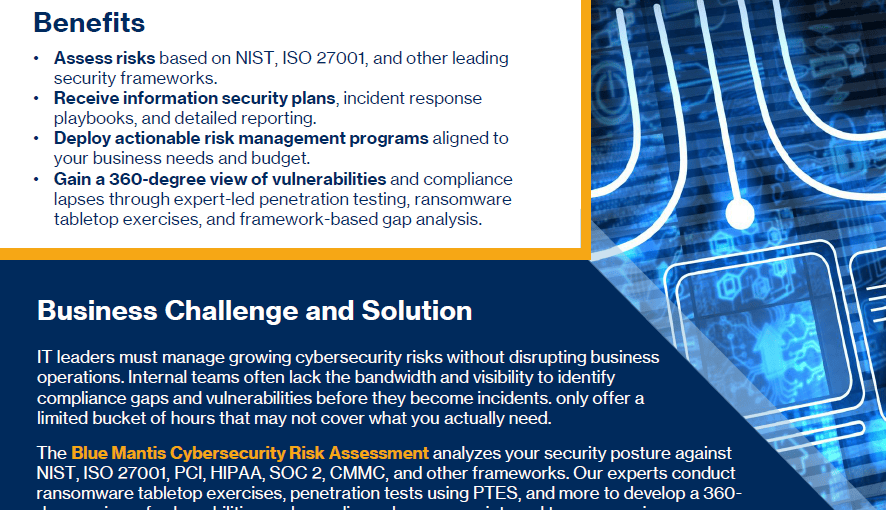
Disparate data, manual processes, and legacy systems still keep organizations from realizing analytics and AI investment returns.
Case Study
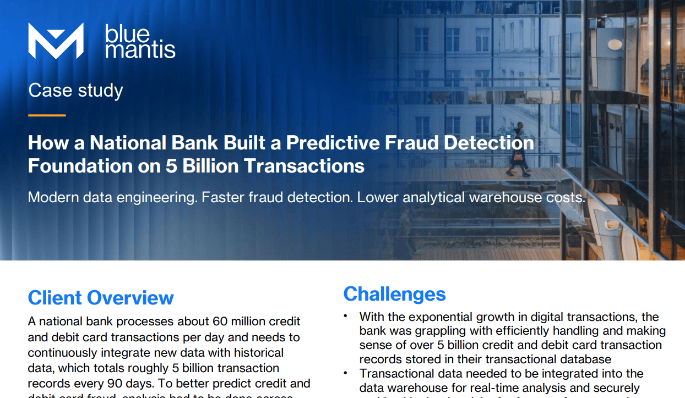
Massive transaction volumes and warehouse memory limits kept a national bank from detecting fraud quickly and cost-effectively.