Back to Basics: What This Week's Outages Really Taught Us

By Jay Martin, CISO, Blue Mantis
If you work in security, you probably felt two things at once this past week: concern, and a strange kind of vindication.
Microsoft 365 kept a big part of the world out of its email for the better part of a day. A new router installation at a remote FAA site in Arkansas has been tied to a nearly five-hour nationwide ground stop and more than 18,000 canceled flights. A software bug at JPMorgan Chase rippled into transactions at other banks and into Zelle payments. Apple Pay and iCloud stumbled after an internal update. A classified internal network at the NSA degraded during scheduled maintenance. And in the middle of all that, attackers turned a trusted marketing script into a malware delivery system on 178 major websites.
So let me answer the question everyone was asking: was this an attack?
Mostly, no. And that’s the part worth talking about.
Not a failure of intelligence
Director of National Intelligence Jay Clayton put it plainly: “We do not see the indicia of a coordinated cyberattack.” His explanation was almost boring. Institutions are patching newly identified vulnerabilities, taking systems down and bringing them back up, and not everything comes back as expected.
Microsoft’s preliminary report reads the same way. A defect from a July fix sat quietly for months, missed by load testing that didn’t reflect production hardware, until a routine failover pushed extra traffic onto a gateway fleet already missing about 14% of its capacity. The FAA, meanwhile, was replacing routers built in 2001 that were supposed to be retired in 2006.
No nation-state zero-day. No rogue AI. A latent bug, a router install, a software glitch, scheduled maintenance.
That’s not a failure of intelligence. That’s a failure of fundamentals: change management, testing that matches production, capacity headroom, and legacy systems nobody got around to replacing. I’m not saying that to be critical. Every one of those organizations has smart people. The basics are just hard to do consistently, and this week showed what happens when a few of them line up the wrong way.
The one that was an attack
The Optimizely incident is the one I’d put in front of your board.
Attackers abused a flaw in Optimizely’s account signup flow and wrote malicious JavaScript into customer projects. Optimizely’s own CDN then served it, with a valid certificate, to visitors of 178 organizations, including Zoom, Salesforce, IKEA and HSBC. It skimmed payment cards, swapped crypto wallet addresses and stole cookies.
Here’s the uncomfortable part: none of those companies had their own infrastructure breached. A script they approved for A/B testing turned on their customers. That’s one of Randy Becker’s five doors, almost word for word. More on that in a minute.
Where AI actually fits
There’s a reason the headlines felt apocalyptic. Fear drives clicks, and plenty of vendors in my own industry love a good crisis. I’d encourage some healthy skepticism about the more cinematic theories going around, including the one where swarms of AI agents are quietly taking down infrastructure. Microsoft’s own report says its outage was not related to cyber or AI agents.
But AI is part of this story. Just not the way the headlines tell it.
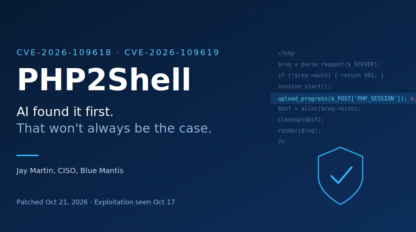
AI is finding vulnerabilities faster than anyone can fix them. CVEs published this year passed 100,000 on November 13, more than double all of 2025, and the people counting them credit AI-driven vulnerability hunting. Microsoft shipped fixes for 1,094 flaws on November 10 alone. Last month’s PHP2Shell flaws, which pushed hosting providers and government agencies into emergency maintenance, were found by researchers working with AI. Senator Mark Warner connected the dots this week: AI is pushing organizations to patch everything at once, on systems never built for that pace of change. A good part of what you watched was defenders patching in a hurry.
Attackers have the same acceleration. On November 13 the FBI issued a FLASH alert on ARTEX, an LLM-driven penetration testing framework that threat actors have turned into an intrusion tool. It has no model of its own, and the FBI says cheap, lightly guarded DeepSeek Flash models dominate. Some intrusions went from initial targeting to privileged access in under three hours. And look at what it goes after: partner and supplier portals, legacy services, third-party integrations. Barracuda disclosed an ARTEX-driven intrusion that started with a former provider’s credential nobody had revoked.
ARTEX didn’t invent new doors. It removed the last excuse for leaving the old ones open.
The people who see the most incidents keep saying the same thing. The UK NCSC’s chief executive, Richard Horne, wrote in this month’s annual review that “AI did not create these cyber security weaknesses; it revealed them.” And David Imbordino, who runs NSA’s Cybersecurity Directorate, said it best back in September: “The basics are no longer boring, and AI can’t outrun the basics.”
Randy’s five doors
Randy Becker, our VP and Principal Security Architect, leads the team that gets paid to legally break into companies. In his Five Doors virtual session this summer, he asked the question I’d want every leader asking right now: if I were an attacker today, human or agent, how would I get in? Not with a zero-day. Through the doors you left open on purpose, never-knew about or forgot existed.
Here’s the short version, with what I’d do about each one.
Door 1: The internet edge. Appliances, VPNs, web apps, APIs, and assets nobody remembers deploying. Internet exposure is now a permanent risk you manage, not a problem you solve. Build the inventory, put secure MFA on everything that authenticates from the internet, prioritize what’s actually being exploited over raw CVSS scores, and delete what you don’t need, because removal is the fastest risk reduction you have. With 100,000 CVEs this year, “patch everything” isn’t a plan anymore. Knowing which exposures matter is.
Door 2: Credentials and sessions sold before you noticed. Infostealers take saved passwords and session cookies from machines you don’t control and sell them in bulk. Industry data puts it at 73% of ransomware victims having prior credential exposure. A stolen session token never sees a login page, so a password reset alone doesn’t evict anyone. Containment is four steps: reset the password, revoke sessions and tokens, audit MFA methods, audit devices. Randy goes further, and I agree with him: delete every MFA method and make the user re-register from scratch.
Door 3: Your help desk. Mandiant documented a group that went from a phone call to the help desk to domain admin in under 40 minutes, with no malware. If the honest answer to “what has to happen before we reset someone’s MFA?” is “it depends on the agent,” your perimeter is a person under time pressure. Write the standard down, including a callback to the number you already have on file. If your service desk is outsourced, get your provider’s standard in writing too.
Door 4: MFA bypass. Adversary-in-the-middle kits relay the real sign-in, so MFA works exactly as designed while the attacker captures the session. Device code phishing goes further: real Microsoft page, real MFA, nothing for the user to spot, and access goes to whoever requested the code. This is a configuration decision, not a project. Use conditional access to block device code flow where it isn’t needed, give admins, finance and executives phishing-resistant MFA, and remove the weaker fallbacks.
Door 5: The connections you built on purpose. Third parties now show up in 48% of breaches. Vendor VPN accounts, your MSP’s privileges, RMM tooling, SaaS and OAuth integrations, even your own SIEM and EDR connectors. And this week, a marketing script on 178 websites. Inventory every vendor account, integration, API key and OAuth grant, and capture six things for each: owner, purpose, privilege level, log source, expiration date, and how you’d kill it in a hurry. Yes, that includes MSPs like us. Ask us the same questions. As Randy puts it, you can outsource the service and systems, but you can’t outsource the consequence.
The doors chain
Randy’s closing point is the one worth sitting with. Doors don’t stay separate. They chain and they chain fast, and AI will make them faster. We’ve never seen all five in a single engagement, but every step is real.
Randy’s line on AI is the best summary I’ve seen: AI is not a sixth door. It makes the five doors faster, cheaper and more convincing. Verizon’s data backs him up. The median threat actor used AI across roughly 15 techniques that were already in the playbook, and under 2.5% were rare or novel.
A swarm of agents doesn’t need a new door. It walks through the ones you already left unlocked, faster, and without getting tired.
AI works for defenders, too
Here’s what gets lost in the fear. The same speed is available to defenders. The Five Eyes cyber agencies said so directly this summer: organizations that build AI into their security operations can find vulnerabilities earlier, spot unusual behavior and respond faster.
That’s the thinking behind Mantis Protect: AI-informed detection, human-led expertise. Our 24×7 in-house SOC uses AI triage to close the known noise before a person ever looks at it, so our analysts and threat hunters spend their time on what’s unusual for you. Then they confirm, contain and document. You get validated incidents, not forwarded alerts.
Here’s how that maps to the five doors:
- The edge: vulnerability management that manages your vulnerabilities and risks, not just raw scan output, ranked by exploitability and business impact instead of CVE counts.
- Credentials: dark web monitoring, so you know when your credentials or data are exposed.
- Help desk and MFA bypass: detection and threat hunting built around identity and behavioral analytics, because in most of these attacks nothing malicious ever runs.
- Connections: managed GRC, including vendor risk management, so every third-party connection has an owner and gets reviewed.
- Your own AI: AI security that identifies and prioritizes risky agent and model activity, and helps you respond to shadow AI and sensitive data loss.
- All five: continuous offensive security, including pen testing, red teaming and AI red teaming, to prove which doors are actually open.
It runs as one program, guided by a dedicated Cyber Maturity Advisor, using the tools you already own. No rip-and-replace.
Where this leaves you
When the next headline hits, don’t react to the news. React to your environment. Where are your gaps? Which door are you least sure about? What’s one meaningful step you can take this week?
If you don’t know where to start, start with proof. A cyber risk assessment or a penetration test will show you which doors are open before someone else, human or agent, walks through them. If you want those doors watched around the clock, by AI that keeps pace and people who know what normal looks like in your environment, that’s Mantis Protect. And if your 2027 budget isn’t final yet, this is the month to get that evidence into it.
Yes, Blue Mantis sells these services. I’d give you the same advice if we didn’t. The basics aren’t boring anymore. They’re where this gets won.
Read Randy’s full Five Doors post: https://www.bluemantis.com/blog/how-attackers-actually-get-in-the-five-doors-we-keep-leaving-open/
See how Mantis Protect works, or book 30 minutes with a security advisor: https://www.bluemantis.com/services/mantis-protect/