
Resilience in an Era of Constant Change

Why infrastructure strategy can no longer be static
By Elton Tucker | Blue Mantis
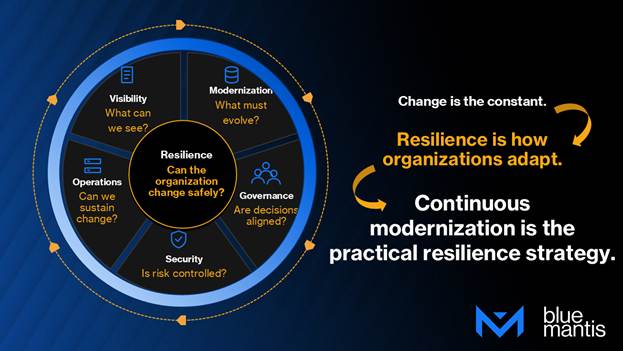
Executive takeaway: Resilience used to mean recovery after failure. Increasingly, it means changing safely before the business is forced to react under pressure. For mid-market organizations, that brings visibility, governance, cybersecurity, cloud economics, AI readiness, and continuous modernization into the same operating conversation.
In the first article in this series, “AI and the New Meaning of Shift Left,” I argued that AI governance has moved closer to the work and must become embedded in the workflows, platforms, identity controls, data protections, and decision paths where AI is actually used. That shift raises the next question: what kind of infrastructure strategy and operating model can support responsible change at that speed? The answer begins with resilience, not simply the ability to recover after disruption, but the ability to adapt safely as technology, business priorities, and risk conditions continue to change.
Resilience Is Becoming an Adaptability Problem
For years, infrastructure resilience was mostly measured by recovery: backups, failover, disaster recovery, and continuity after an outage. Those capabilities still matter. They are just no longer enough.
Technology leaders now have to manage overlapping forms of change: shifting vendor economics, evolving regulatory expectations, cybersecurity threats, cloud optimization, workforce transformation, and accelerating AI adoption. In that environment, the more useful test is not only whether systems can recover. It is whether the organization can change direction without creating instability.
That is an adaptability problem. And it often exposes a hard truth: environments designed for stability in a slower-moving world are not always designed for change.
Platform Disruption Is a Useful Wake-Up Call
The VMware discussion is a useful example because it was never only about licensing. For some organizations, cost was the immediate concern. For others, it raised broader questions about platform direction, workload portability, vendor concentration, and long-term operating models.
The lesson was consistent: changing a foundational infrastructure platform is hard when applications, operations, governance, support models, and team structures have all grown around a single assumption.
| Executive questions this should raise |
| How portable are our workloads? |
| Do we understand application dependencies well enough to move safely? |
| Where do vendor, platform, or operating-model assumptions create concentration risk? |
| Do we have enough visibility to make informed modernization decisions? |
Resilience Requires a Shared Outcome
One of the most common obstacles to resilience is the historical separation between infrastructure ownership and application ownership. Infrastructure teams are often measured on availability, standardization, security, and cost control. Application teams are often measured on delivery, functionality, customer experience, and business outcomes. Neither perspective is wrong.
The challenge emerges when transformation requires these groups to move together. Cloud migrations stall when dependencies are unclear. AI capabilities appear faster than governance models can adapt. Security controls are treated as obstacles rather than operating requirements.
Organizations that make meaningful progress tend to focus less on ownership boundaries and more on shared outcomes. Infrastructure, security, application, data, and business stakeholders need a common understanding of what must become true for change to occur safely.
Practically, this starts with assessment: understanding current assets, dependencies, risks, costs, and operating constraints. From there, organizations can modernize intentionally, manage the environment continuously, and secure the work at each stage rather than treating security as a final checkpoint.
Visibility Is the Foundation
Modernization decisions become slower and riskier when an organization cannot confidently answer basic questions about its own environment: what applications exist, who owns them, what they depend on, where business-critical data lives, and what changes would affect downstream systems.
The reality is straightforward: you cannot modernize what you cannot see. Visibility into applications, infrastructure, identity, security controls, utilization, operational ownership, and data flows has become a prerequisite for resilience.
Architecting for Change
Architecting for change does not mean chasing every new platform or redesigning for theoretical flexibility. It means making deliberate choices that reduce lock-in, clarify dependencies, and let the organization respond when business, security, or operating conditions shift.
- Modular application and integration patterns
- Infrastructure as code and automated provisioning
- Policy-driven governance and security controls
- Cross-platform observability and operational visibility
- Workload portability where it creates business value
AI, Data, and Sovereignty Raise the Stakes
AI is often presented as a conversation about models. For many organizations, the more important conversation is readiness: data quality, governance, security controls, infrastructure capacity, network design, operational ownership, and risk management.
This connects directly to practical modernization priorities: cybersecurity-first design, data and AI readiness, digital workplace enablement, and cloud and modern infrastructure supported by consultative professional and managed services. Security is not a late-stage review in that model; it is part of how the work is assessed, designed, delivered, and operated.
AI also makes sovereignty and compliance more visible. Leaders increasingly need to understand where data is stored, how it is processed, who can access it, and what controls surround AI-enabled workloads. These are not side conversations. They are part of responsible modernization.
Continuous Modernization Is the Practical Resilience Strategy
Many organizations modernize only when circumstances force action: vendor changes, security incidents, regulatory requirements, capacity limitations, data center exits, or application instability. The problem is not modernization. The problem is modernization performed under pressure.
Organizations that modernize continuously as part of normal business cycles typically have more options when disruption arrives. Continuous modernization does not mean constant disruption. It means steadily reducing technical debt, improving visibility, simplifying dependencies, standardizing platforms, and aligning governance with operational reality. It also means treating management, monitoring, optimization, and security as ongoing disciplines rather than post-project activities.
Over time, that work creates optionality. And optionality is one of the most practical forms of resilience an organization can possess.
Why This Matters for Mid-Market Organizations
Mid-market organizations often carry enterprise-class expectations with smaller teams and tighter budgets. They need to support security, compliance, modernization, cloud operations, and business growth without creating a collection of disconnected initiatives.
This is where the conversation has to become integrated. Infrastructure strategy, cybersecurity, application modernization, AI readiness, data governance, and managed operations need to work together as part of a common operating model.
| What executives should look for | Why it matters |
| Visibility across applications, infrastructure, identity, security, and data | Reduces surprise and improves decision quality. |
| Security and governance designed into modernization | Prevents speed from becoming unmanaged risk. |
| Cloud and platform choices tied to workload and business outcomes | Preserves flexibility while managing cost. |
| AI readiness grounded in data, operations, and controls | Supports adoption without creating avoidable exposure. |
Where Blue Mantis Can Help
None of these steps exist in isolation. Identity decisions affect data access. Infrastructure choices affect visibility, resilience, and economics. Security controls affect how quickly new use cases can move into production. Governance determines whether the organization can demonstrate that those decisions remain inside acceptable boundaries.
This is where Blue Mantis can help. Rather than treating AI readiness, modernization, or resilience as standalone technology initiatives, we work across the underlying disciplines that determine whether change can move from experimentation to responsible scale:
- Modernization and infrastructure — rationalizing the platforms, workloads, and dependencies the business relies upon.
- Identity and access — establishing appropriate access patterns for users, applications, services, and emerging AI agents.
- Data governance — understanding what data can be accessed, where it can move, and what obligations follow it.
- Cybersecurity and resilience — embedding visibility, protection, auditability, and recovery into modern workflows.
- FinOps and cloud economics — making consumption, cost, and business value visible as workloads scale.
- AI readiness and adoption — helping organizations identify viable use cases and establish a repeatable path from experimentation to production.
Conclusion
Resilience is no longer defined solely by whether systems recover after something breaks. Recovery remains important, but it is not sufficient.
The more useful question is whether the organization can change safely. Can workloads move when vendor economics shift? Can AI adoption scale without exposing sensitive data? Can infrastructure adapt to new regulatory requirements? Can teams modernize without creating operational instability?
The organizations that navigate the next several years successfully will not necessarily be the ones with the largest budgets or the newest technologies. They will be the ones with enough visibility, governance, operational discipline, and architectural flexibility to adapt before change becomes a crisis.
Infrastructure strategy can no longer be static. Modernization has to become an ongoing operating discipline rather than an emergency response. Because resilience is ultimately not about predicting the future. It is about creating enough optionality to respond when the future changes.
Practical starting point: The right starting point is not a tool decision. It is shared understanding: what outcomes must the business support, what risks must be controlled, what constraints are real, and where modernization will create the most practical optionality. From there, the work should move through a practical cycle of assessment, modernization, management, and security, with business outcomes remaining the measure of success.
Sources and Further Reading
Blue Mantis Perspective
- Needs that Blue Mantis Meets, [bluemantis.com]
Resilience and Risk Management
- McKinsey & Company, Business Resilience (2026) [mckinsey.com]
VMware and Infrastructure Strategy
- Gartner, Consult the Board: VMware Strategy and Alternatives [gartner.com]
AI Readiness and Governance
- Microsoft, Is Your Workplace Ready for AI? How to Assess Readiness Before Adoption (2026) [microsoft.com]
- NIST AI Risk Management Framework (AI RMF) [nist.gov], [nist.gov]
- ISO/IEC 42001: Artificial Intelligence Management System Standard [iso.org]
Data Sovereignty and Regulatory Considerations
- Microsoft Sovereign Cloud Overview [microsoft.com]
- Microsoft Learn: AI Workloads and Sovereignty [learn.microsoft.com]
Cloud Economics and FinOps
- FinOps Foundation, Optimize Usage & Cost Framework [finops.org]
Modernization and Lifecycle Planning
- CNCF TAG App Delivery, CNCF Platforms White Paper [cncf.io]
- The Open Group, IT4IT Reference Architecture [opengroup.org]
- About the author:
- Elton Tucker is an Enterprise Architect with a background in digital transformation, enterprise architecture, strategy consulting, solution and cloud architecture, and IT outsourcing. Over the past 30 years he has worked with multiple global 500 organizations across industries including Information Technology, Financial Services, Insurance, Telecommunications, Manufacturing, Health Care / Life Sciences, Energy, and Automotive.
In his current role as pre-sales enterprise architect for Blue Mantis, Elton brings his extensive experience to help guide across multiple technical domains and disciplines. His goal is to simplify, clarify, and communicate programs of change to drive business value.