

What Is the True Cost of AI?

Uber burned through its entire 2026 AI budget by April. Four months. A company that spends $3.4 billion a year on R&D, with some of the best engineers and finance teams in the world, missed its own AI cost forecast by a factor of three. If they can get it that wrong, what are the odds your budget is right?
This is the first post in a six-part series on the enterprise AI journey: cost, ROI, optimization, planning, first steps, and scaling past the pilot. We are starting with cost because everything else depends on it. And because it is the number most organizations get wrong.
The costs everyone budgets for
Let’s give credit where it’s due. Most AI budgets do a reasonable job covering the visible stuff. It helps to organize it the way the stack is actually built: four layers, each with its own price tag:
- Infrastructure. Cloud compute, GPU time, storage, networking. Familiar territory for anyone who has run a cloud migration. Painful, but predictable, or so it seems.
- Models. The intelligence itself: API access to frontier models, enterprise model licensing, or the cost of hosting your own. Usually the line item the vendor put in the proposal, so it is the one that makes it into the spreadsheet. Worth noting: models are swappable, and picking one by popularity instead of fit is one of the quieter ways money leaks.
- Platform. The connective tissue most budgets skim past: orchestration, the tooling that grounds models in your actual data, and the guardrails that enforce governance. This is what makes a model that knows a lot about the world know something about your business. Small line item on day one. Rarely small by year one.
- Applications. The layer that delivers value to a person or a process. Copilot seats and chat subscriptions, yes, but also the invisible kind: a workflow that reads invoices and routes them for approval, a scoring engine sitting quietly inside your CRM. Plus the initial build: implementation partners, a pilot team, maybe a new hire or two.
Add those up and you get a number that looks complete. It is not. And here’s the trap with a layered stack: problems rarely announce themselves at the layer where they actually originate. A bad copilot answer is usually a platform gap, and a platform gap often traces back to an infrastructure or model decision made too early. The same is true of costs.
Gartner’s research on generative AI costs puts it bluntly: organizations moving from pilots to production get a rude awakening on cost, and through 2028, at least half of GenAI projects are expected to overrun their budgets, mostly due to architectural choices and operational gaps, not sticker price (Gartner, “10 Best Practices for Optimizing Generative and Agentic AI Costs,” March 2026).
In other words: the part of the iceberg you can see is not the part that sinks the ship.
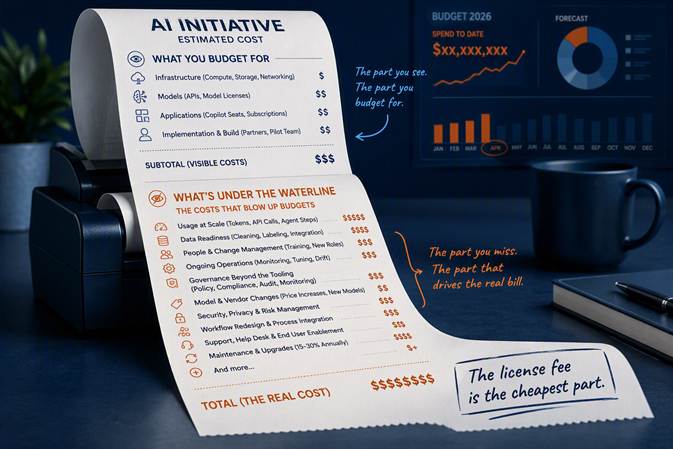
The costs that blow up budgets
Here are the categories that most consistently get underestimated, and by the widest margins.
1. Usage at scale: the tokenomics problem.
The single biggest shift in AI economics: pricing is moving from seats to consumption. Call it tokenomics, the economics of paying per unit of AI work. A “token” is roughly a word-sized chunk the model processes, and you are billed for every one. You do not pay for access; you pay for every task, every token, every agent step.
And it compounds across the stack: one request in an application can trigger orchestration runs at the platform layer, which fan out into multiple model calls, each burning metered infrastructure underneath. Four layers, four meters, one invoice nobody forecasted. That’s what caught Uber: Claude Code spread to roughly 5,000 engineers faster than finance models anticipated, with some engineers running up $500-$2,000 a month each (The Information, 2026). Here’s the uncomfortable twist: the tool worked. Adoption success is what broke the budget.
And it is structural, not a one-off. Gartner notes agentic workflows can consume 5 to 30 times more tokens per task than a simple chatbot query. Per-unit prices keep falling; total bills keep rising. Even Microsoft reportedly pulled back most internal access to an AI coding tool in 2026 over the same math.
2. Data readiness
Your models are only as good as the data underneath them, and most enterprise data is not ready. Cleaning, integrating, labeling, governing: in many programs this quietly becomes the largest single cost center. Gartner predicts that through 2026, organizations will abandon 60% of AI projects that are not supported by AI-ready data, and 63% of organizations admit they lack, or are not sure they have, the data management practices AI requires. That work does not show up in the vendor proposal. It shows up six months in, as a surprise.
3. People and change management.
Tools do not create value; people using tools differently do. Training, workflow redesign, new roles, the productivity dip while teams adapt: this is the cost category with the least visibility and arguably the most impact. MIT’s “State of AI in Business 2025” study found that 95% of GenAI pilots delivered no measurable P&L impact, despite an estimated $30-$40 billion invested. The failures were not mostly about model quality. They were about integration into real workflows: a people-and-process problem wearing a technology costume.
4. Ongoing operations.
AI is not a project with an end date. Models drift, prompts need tuning, vendors change pricing, regulations evolve. Industry benchmarks commonly put annual maintenance at 15-30% of the original build cost, every year, forever. If your budget treats AI like a one-time capital expense, it is wrong by design.
5. Governance beyond the tooling.
The platform layer can enforce your policies, but someone has to write them first. Policy design, compliance reviews, audit trails, monitoring for misuse: that is organizational work, not software, and it does not come bundled with any license. Survey data cited in coverage of the Uber overrun found only 43% of organizations have formal AI governance policies. The other 57% are not avoiding the cost. They are deferring it, usually until an incident makes it urgent and expensive.
A simple way to think about true cost
Here is one mental model, not the only one, but a useful one. Every AI initiative has four cost legs, and they are the same four things you need to succeed with AI in the first place:
- Technology – The four-layer stack: infrastructure, models, platform, applications, and the usage running through it.
- Data – Getting data ready, keeping data governed, and paying for that continuously.
- People – Talent, training, and the change management that determines whether anyone actually uses the thing.
- Process – Integration, workflow redesign, governance, and ongoing operations.
Most budgets fund the first leg thoroughly, the second leg partially, and the last two barely at all. A rough rule of thumb from the patterns above: if your total budget is less than double your technology line, you are probably underfunding the other three legs, and those are exactly the ones that decide whether you end up in MIT’s 5% or its 95%.
One more practical move: budget for adoption success, not just adoption failure. Ask, “what does this cost if it works and everyone uses it?” That is the question Uber’s spreadsheet did not ask.
| Quick check: Before your next budget review, answer 12 questions across technology, data, people, and process. Take the AI Budget Self-Check |
Where this series goes next
None of this is an argument against investing in AI. Worldwide AI spending is headed toward roughly $2.59 trillion in 2026 (Gartner), and sitting out is not a strategy. It is an argument for going in with a real number instead of a hopeful one.
Because here is the thing: you cannot measure ROI until you know what you are actually spending. If your denominator is missing half the iceberg, every return calculation you make is fiction: flattering fiction, but fiction. That is exactly where we are headed in the next installment: how to measure ROI for AI in a way your CFO will actually believe.
If you are staring at your own AI budget wondering which of these categories you have missed, that is a good conversation to have before the invoices arrive. It is the kind of thing we work through with leadership teams in our AI Workshop: a few hours mapping your real cost picture can save a few quarters of explaining variances.
| Turn the article into action: Download the five-minute AI Budget Self-Check and see whether your budget is forecasting, tracking, or still guessing. Get the checklist |
Sources cited
- Gartner, “10 Best Practices for Optimizing Generative and Agentic AI Costs” (March 2026): 50% of GenAI projects to overrun budgets through 2028; agentic workflows consume 5-30x more tokens per task.
- Gartner (2026): 60% of AI projects without AI-ready data will be abandoned through 2026; 63% of organizations lack adequate data management practices; ~$2.59T worldwide AI spending forecast for 2026.
- MIT NANDA, “The GenAI Divide: State of AI in Business 2025” (July 2025): 95% of GenAI pilots show no measurable P&L impact; $30-$40B invested.
- The Information / Fortune / Forbes (April-May 2026): Uber exhausted its 2026 AI budget in four months; $500-$2,000/month per engineer; $3.4B R&D spend; Microsoft internal pullback; 43% governance stat.
- Industry benchmarks (2026): 15-30% annual maintenance cost; flagged as directional, not from a tier-1 analyst firm.
About the Author
Trey Bayne is a Senior Solution Architect at Blue Mantis and a business-first technologist with nearly two decades of experience across data analytics, cloud architecture, and advisory services. He has worked with organizations ranging from regional institutions to large enterprises across financial services, insurance, manufacturing, and professional services. At Blue Mantis, Trey helps clients evaluate and implement modern analytics platforms including Microsoft Fabric, Power BI, and cloud data architectures, while navigating the legacy constraints and operational realities that come with real organizations. He believes technology should simplify organizations, not complicate them.