
Your endpoint data should be driving your hardware decisions

Cloud optimization has become a standard IT discipline.
We look for idle resources, oversized workloads, unused licenses, and services that cost more than the value they create. Technology consumption will keep growing, so IT leaders need to understand whether additional spending is producing additional business value.
We apply much less scrutiny to how our people spend their time.
IT teams are being asked to lead AI adoption, cybersecurity, modernization, analytics, automation, and business transformation. They also still have boxes arriving at the loading dock.
Someone has to order each laptop, receive it, configure it, ship it, track it, recover it, wipe it, and eventually dispose of it. That work did not disappear when IT became more strategic. It landed beside everything else. This is where many IT capacity problems begin.
IT capacity is an operating-model problem
When the workload exceeds available hours, hiring is the obvious answer. Sometimes it is the right one. But hiring adds capacity one person at a time. The company still has to recruit, train, manage, and retain that person, often to handle work that is necessary but highly repeatable.
I have seen skilled IT employees spend large parts of their week coordinating laptop shipments, troubleshooting inconsistent builds, tracking down missing devices, and maintaining spreadsheets because the systems around the work are disconnected. Every task has a reason behind it. Together, they consume time the business expects IT to spend somewhere else.
IT leaders should look at internal effort with the same discipline they apply to cloud spending. Where are skilled employees producing unique business value? Where are they compensating for disconnected tools and processes? Where could integration, automation, or a specialized partner deliver the outcome more consistently?
Endpoint lifecycle management is a good place to start.
Most refresh decisions use incomplete information
I have had versions of the same device-refresh conversation with customers for years. How old are the laptops? When do the warranties expire? Which models are standard? How many devices need to be replaced next year? All reasonable questions.
But rarely does anyone start with the experience those devices are delivering today.
Two laptops purchased at the same time can perform very differently. A newer, lower-cost model may create more support issues than the premium model it replaced. An older device may still work perfectly well for one employee while slowing another person down every morning. Still, many refresh decisions come back to age, warranty dates, available budget, and whichever users are complaining the loudest.
There is better information available. It just rarely reaches the people making the hardware decisions.
The management platform already sees more
Many organizations think about Microsoft Intune as a place to enroll devices, deploy applications, apply policies, and manage security settings. For many, that is where the conversation stops.
Microsoft Endpoint Analytics can provide information about startup performance, application reliability, work-from-anywhere readiness, and battery health. Microsoft describes it as a way for IT teams to assess and improve the user experience across managed devices. Some advanced capabilities require additional licensing, but many organizations are not fully using the information already available to them.
The startup performance report examines the experience from power-on through sign-in and the point when the user has a responsive desktop, including boot and sign-in scores, device-level history, and insights into issues such as Group Policy delays and slower hard disk drives. Application reliability reporting can surface crashes and stability trends, and depending on licensing, advanced analytics can add deeper information about device models, resource performance, anomalies, and battery health.
This is useful information for the endpoint team. It could be useful to procurement too.
Procurement should be a feedback loop
Here is what I usually see. The endpoint team manages Intune. The help desk hears about slow devices and unstable applications. Procurement negotiates laptop pricing. Finance determines the refresh budget. Asset records may sit in another system entirely. Everyone has a piece of the picture. Few organizations bring those pieces together.
Intune does not know what the company paid for every laptop. Endpoint Analytics will not create a procurement strategy on its own. Someone still needs to look across device experience, hardware models, acquisition cost, age, warranty status, and the needs of different users.
Once that happens, the buying conversation gets more useful. Are certain models consistently starting faster than others? Are stability problems concentrated on specific hardware? Is a lower-cost device creating enough user frustration and support activity to erase the initial savings? Is the most expensive model producing a noticeably better experience?
The same information can challenge a fixed refresh cycle. A four-year-old laptop may still perform well for the employee using it. Another model may create problems after two years. Instead of replacing an entire group because the calendar says it is time, IT can direct limited budget toward the devices causing the most disruption.
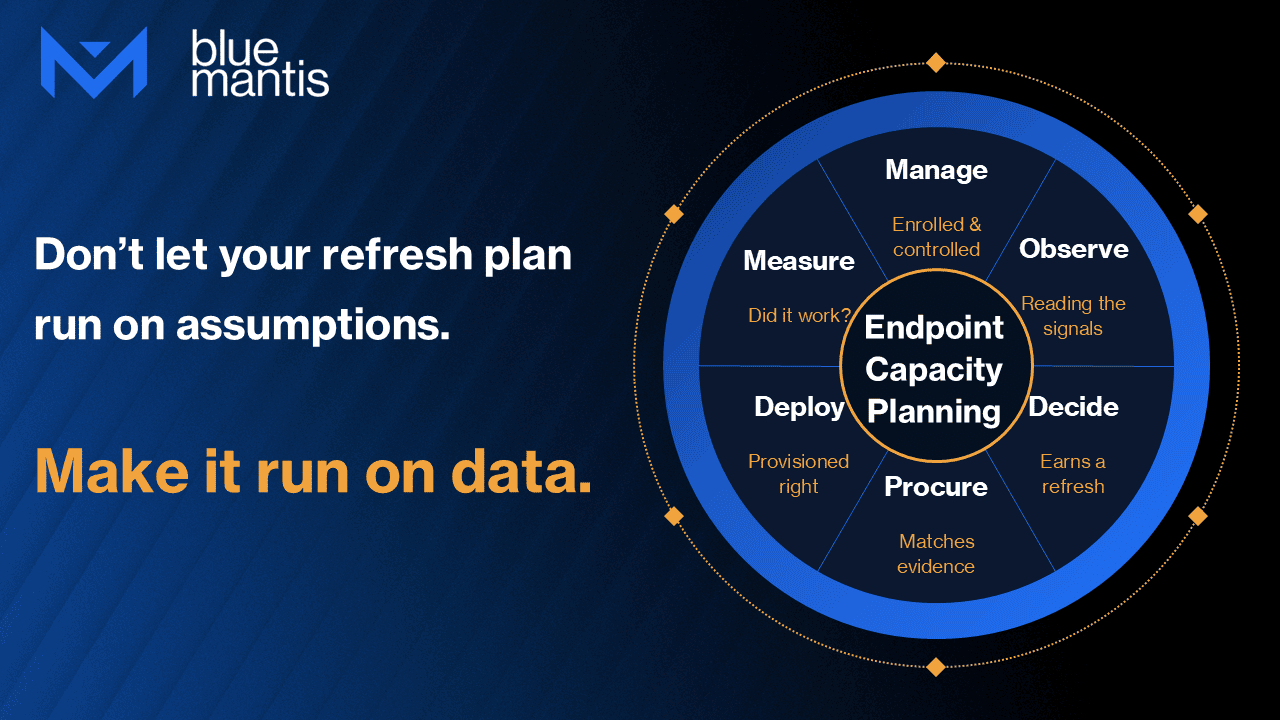
No single score should make the purchasing decision. The data should give IT, procurement, and finance better evidence when they make that decision together. The model is straightforward: manage, observe, decide, procure, deploy, measure again. Most organizations have several of those pieces. They do not yet operate as one system.
Better visibility starts with modern device management
Organizations still managing devices primarily through traditional Active Directory and legacy endpoint tools may not have the cloud management foundation needed to capture and use this information effectively.
Blue Mantis helps customers modernize device management through Microsoft Intune and Windows Autopilot, building a stronger foundation for device visibility, policy delivery, application management, security, and lifecycle automation. Microsoft positions Windows Autopilot as a way to set up, reset, repurpose, and recover devices while reducing the deployment infrastructure and effort IT must maintain.
Once that foundation is in place, we help customers interpret the endpoint data already available to them and bring it directly into refresh and hardware-selection discussions. The conversation can move beyond:
“These devices are four years old.”
It can become:
“This model is producing slower startup times and more reliability issues than the alternatives. Here is what we paid for it, here is how it is performing, and here is where we should focus the next refresh.”
The data may also show that some devices are performing well beyond their planned replacement date. Extending their useful life could free budget for hardware creating a measurable employee experience problem. That is a better reason to replace a laptop.
The platform cannot unbox the device
Analytics can help identify what should be replaced. It cannot receive a shipment, attach an asset tag, register a device for Windows Autopilot, store spare inventory, or recover an old laptop from a remote employee. Eventually, someone has to touch the device. Physically.
This is where the partner ecosystem extends the technology platform into the physical world. Through the Blue Mantis Technology Innovation Center, customers can move repeatable device operations into a purpose-built environment. TIC supports receiving and inventory, provisioning, Autopilot registration, updates, asset tagging, warehousing, deployment, device recovery, reprovisioning, and certified disposal.
The internal IT team still governs the environment, defines standards, and makes the decisions that matter. It does not need to personally receive, configure, ship, retrieve, and retire every laptop. A strong partner ecosystem should remove work from the operating model, not add another product or handoff for IT to manage.
The next optimization target is IT capacity
The management platform can provide automation and experience data. That data can improve refresh and purchasing decisions. A partner can procure the hardware and execute the physical lifecycle. Internal IT can maintain control without carrying every task from beginning to end. The individual pieces create value today. Connecting them more closely is where the operating model gets interesting.
If your current hardware plan is driven mostly by device age, warranty dates, and user complaints, there is probably useful endpoint information missing from the decision — and IT capacity sitting inside your operating model that a connected platform and partner ecosystem could recover.
Endpoint devices are one place this shows up. For many IT teams, they are not the only place.
If your team is absorbing this kind of manual, repeatable work across more than just laptops — licensing sprawl, overlapping security tools, disconnected device management — it is worth asking how much of your Microsoft 365 investment is already positioned to solve it. The Blue Mantis Modern Endpoint Orchestration Assessment maps where that capacity is going today and what consolidating around the M365 ecosystem you already own — Intune, Defender XDR, Entra ID, Purview — could save, with a CFO-ready cost analysis and a phased modernization roadmap.
Get the Modern Endpoint Orchestration Assessment →
You already have a refresh plan. The question is whether the devices themselves had any input.
About the author
Josh Morganthall is a visionary leader at Blue Mantis, transforming complex technical challenges into innovative solutions. With a rich background in cloud, data center virtualization, and networking, he excels in aligning technology with strategic business value. His early career focused on enhancing backup and disaster recovery solutions, paving the way for his expertise in cloud technologies.
Driven by a passion for a more connected world, Josh champions the shift from traditional IT to a work-from-anywhere model. He believes in working smarter (and harder!), and his extensive experience across various IT roles makes his solutions imaginative AND practical. Josh’s commitment to creating a collaborative future is highlighted in every project he undertakes.