

You Can Buy the Tool. You Can’t Buy the Fitness.

There’s a scene I keep seeing play out, and you’ve probably been in it.
A leader stands up at an all-hands and announces the AI rollout. The slide has a logo, a license count, and a projected productivity lift of around 30%. There’s polite applause. The licenses get provisioned. Six months later, the same leader is in a quieter room asking why nothing has changed.
The answer is almost never the tool.
I’ll grant the obvious thing up front: everyone is tired of being told to transform. The pace of change is exhausting, the vendor pitches are relentless, and “AI-powered” has become a phrase that means everything and therefore nothing. That fatigue is real and it deserves acknowledgment. It also doesn’t change what’s coming. The trajectory isn’t up for debate. The only useful question left is not whether to move, but how deliberately you intend to do it.
So here’s the sharp version: buying the tool is the cheap part. The part you cannot procure is your team’s ability to use it. You can buy the tool. You can’t buy the fitness.
Why this rollout isn’t like the last one
I’ve watched organizations go through cloud, mobile, and the SaaS wave. Most leaders carry a mental model from those years: pick a vendor, train people on the new interface, manage the change curve, declare victory. That model is misleading them now, and I see it happen more than I’d like.
Those earlier shifts changed the tools but mostly preserved the workflow. The accountant still closed the books, just in a browser instead of a desktop app. The salesperson still ran the pipeline, just in Salesforce instead of a spreadsheet. AI doesn’t preserve the workflow. It rearranges what tasks exist, who does them, where judgment lives, and what “done” looks like.
Think about a research analyst whose AI tool can produce a credible first draft of a market summary in 90 seconds. That person isn’t doing the same job faster. They’re doing a different job, where the work is now reviewing, verifying, and adding the insight a model can’t. You don’t train people through that shift in a one-hour webinar. You build a capacity in them that has to keep adapting, because the ground will keep moving.
That capacity is what I call change fitness. Not a one-time training event. An ongoing muscle, built in individuals and in teams.
What it looks like
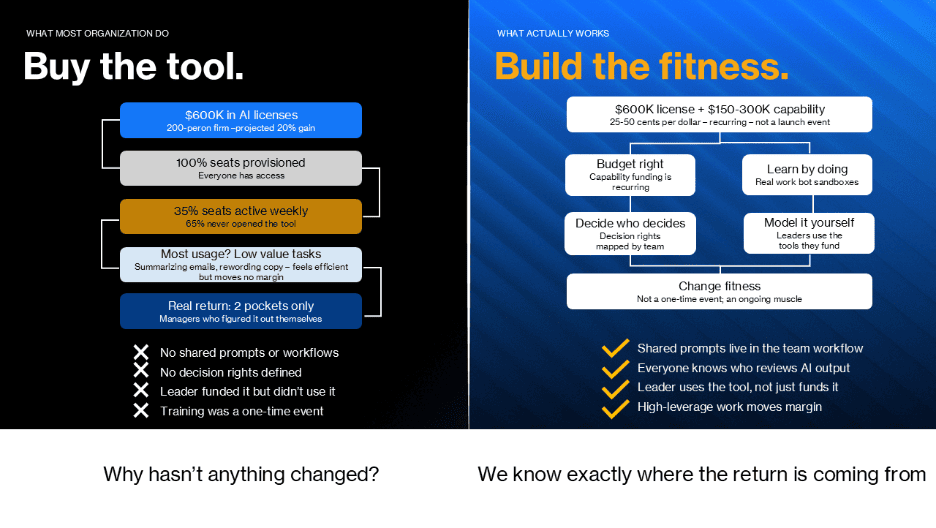
I worked with a 200-person professional services firm that bought enterprise AI licenses last year. The sticker math was clean: roughly $600,000 a year in licenses, against a projected 20% productivity gain across the billable workforce. On paper, an easy decision.
Twelve months in, the usage data told a more honest story. About 35% of seats were active in any given week. Of those, most usage was clustered in low-value tasks: summarizing emails, rewording paragraphs, the kind of thing that produces a feeling of efficiency without much measurable output.
The high-leverage work was different: restructuring how analysts prepare client deliverables, building shared prompts and review patterns into the team’s workflow, deciding which tasks should now start with an AI draft. That was happening in maybe 2 pockets of the firm. Both led by managers who had taken it on themselves to figure it out.
Those 2 pockets generated real return. The other 95% of the organization generated an expensive subscription and a vague sense of disappointment. The tool wasn’t the problem. The tool worked exactly as advertised. What was missing was the deliberate work of building fitness in the people meant to use it.
Fitness is individual and team
Most leaders, when they finally accept that training matters, default to individual training. Send everyone to a course. Offer certifications. Track completion rates. This is necessary but nowhere near sufficient, and treating it as the answer is the second mistake on top of the first.
Individual fitness is real: curiosity, a willingness to experiment in your actual work, comfort collaborating with something that is sometimes confidently wrong, the humility to look like a beginner again. But a team full of individually capable people will still stall if the team itself hasn’t done its own work.
Who reviews AI-generated output before it goes to a client? When the model surfaces a recommendation, who has authority to act on it and who has to be consulted first? Where does the team’s shared context live, so that one person’s hard-won prompt or workflow isn’t trapped in their head? These questions don’t answer themselves. Ambiguity around them is where adoption quietly dies.
What leaders have to do
If you accept the premise, the prescription is less mysterious than it sounds. Four things matter more than the rest.
Budget for capability, not just licenses. A useful rule of thumb: for every dollar you spend on AI tools, plan on 25 to 50 cents on enabling people to use them. And treat that as recurring, not a launch event.
Make space for learning that looks like working. Real fitness is built during real work, not in sandboxes. That means giving people permission to experiment on live tasks, including the right to fail visibly without it becoming a performance issue.
Decide who decides. Map out, by team, where AI now sits in the workflow and what the new decision rights are. Vague is fatal. Written down is better than spoken. Practiced is better than written.
Model it yourself. Leaders who sponsor AI adoption but don’t personally use the tools cannot credibly lead this change. Your team is watching whether you do the work or just fund it.
None of this is glamorous. None of it shows up in a vendor demo. All of it is what separates the organizations that get real leverage from the ones that get an expensive subscription.
The choice you have
The trajectory isn’t up for debate. AI is going to keep reshaping how your people work, what you spend on, and what your competitors are capable of. You don’t get to opt out of that.
What you get to decide is whether you lead the change deliberately, investing in your people, building team-level practices, modeling the work yourself, or whether you get dragged through it, one disappointed quarterly review at a time.
I have this conversation with leaders every week. The ones who are getting real return from AI aren’t the ones with the biggest budgets or the most sophisticated tools. They’re the ones who got honest about the gap between what they bought and what their teams were ready to do, and then did something about it.
You can buy the tool. You already have, or you will. The fitness is the part that’s still on you. If you’re not sure where your organization stands, that’s usually the right place to start the conversation.
About the Author
Trey Bayne
Senior Solution Architect, Blue Mantis
Trey Bayne is a Senior Solution Architect at Blue Mantis and a business-first technologist with nearly two decades of experience across data analytics, cloud architecture, and advisory services. He has worked with organizations ranging from regional institutions to large enterprises across financial services, insurance, manufacturing, and professional services. At Blue Mantis, Trey helps clients evaluate and implement modern analytics platforms including Microsoft Fabric, Power BI, and cloud data architectures, while navigating the legacy constraints and operational realities that come with real organizations. He believes technology should simplify organizations, not complicate them.