


Microsoft Ignite 2025: Top AI Innovations and Enterprise Impact
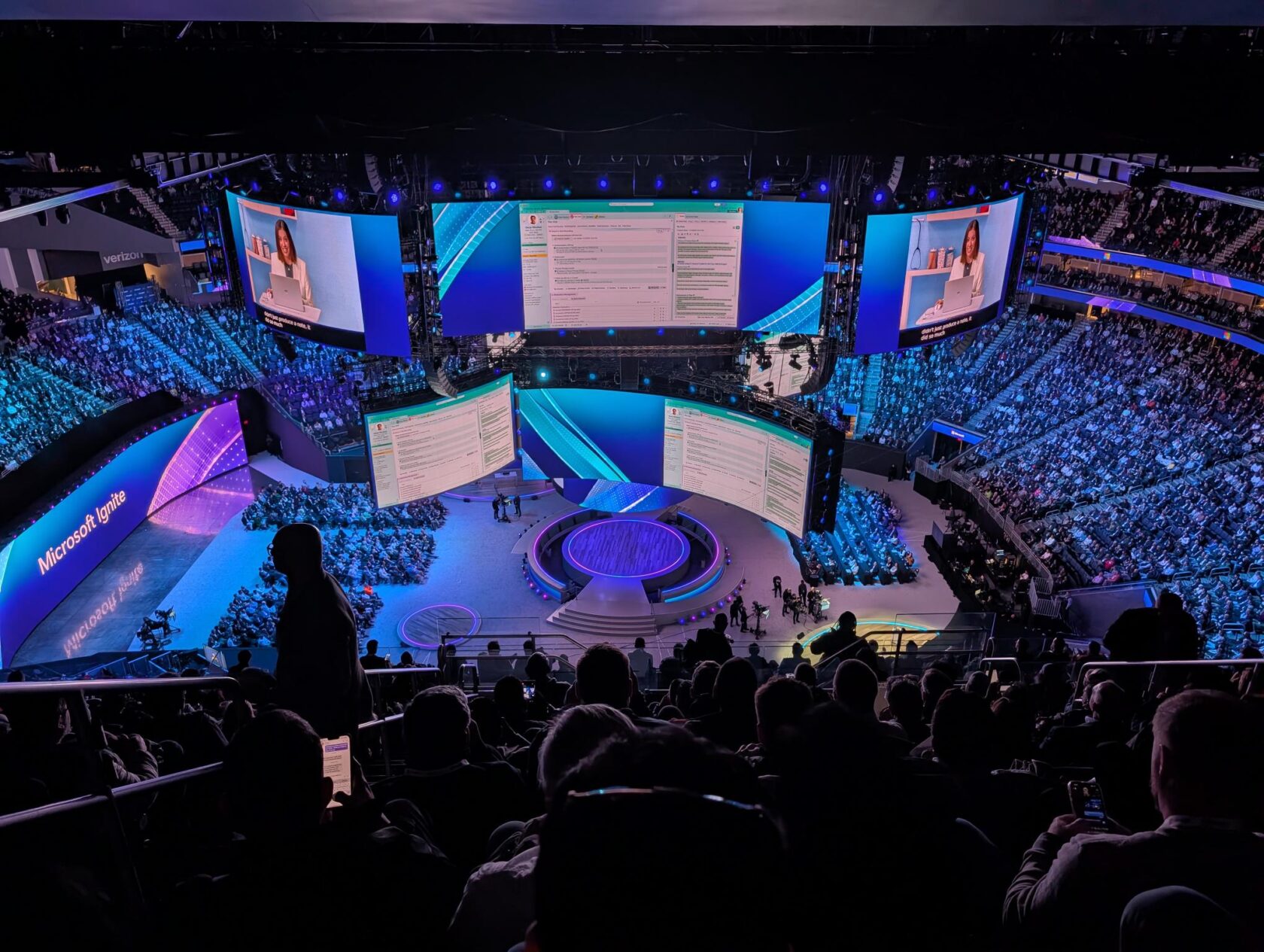
Microsoft Ignite 2025 unveiled a wave of AI advancements aimed at making AI an integral, scalable part of every enterprise, including Fabric IQ, Foundry IQ, Azure AI Foundry platform enhancements, and Agent 365. At Blue Mantis, we are excited about the new offers. Here’s why you should be too.
Fabric IQ: Turning Data into Business Intelligence
What it is: Fabric IQ adds a semantic intelligence layer on top of Microsoft’s unified data platform (Fabric). It uses a common business ontology and knowledge graph to represent how data points relate in business terms – customers, products, processes, etc. This layer powers AI Data Agents and Operations Agents that can interpret data in context. Data Agents can answer complex business questions by understanding the meaning behind data (beyond raw numbers), while Operations Agents can proactively monitor metrics and trigger actions based on business rules. Notably, Fabric IQ bridges structured and unstructured data: its data agents can now pull insights not just from databases but also from documents and files indexed via Azure AI Search.
Why it matters: Fabric IQ breaks down data silos and translates raw data into actionable business insights. For executives, this means decisions and analytics are enriched with real business context – AI can recognize patterns like an experienced analyst would. The unified ontology ensures everyone from BI teams to AI agents works off the same definitions and metrics, reducing confusion. By supporting unstructured content (like manuals or emails), Fabric IQ lets AI draw on all your institutional knowledge when answering questions or diagnosing issues. In short, it enables a shift from traditional reporting to autonomous intelligence: imagine a virtual operations analyst that not only flags an inventory shortfall but also knows the likely causes and suggests next steps, based on both data and written policies. This capability can lead to more proactive management and quicker responses to business challenges.
Blue Mantis alignment: Blue Mantis helps clients implement Fabric IQ by defining the right ontology and connecting relevant data sources. Our AI & Data Enablement services will integrate your existing databases, data lakes, and document repositories into Fabric, so that the Fabric IQ agents have a complete, governed view of your business data. We ensure that unstructured data (like PDFs or SharePoint files) is indexed and accessible to Fabric’s AI, while applying security controls so sensitive information is handled appropriately. The result is an intelligent data foundation tailored to your business, ready to drive real-time insights and automation.
Foundry IQ: Unified Knowledge for AI Agent
What it is: Foundry IQ is a new Azure AI service that provides centralized enterprise knowledge bases for AI applications. It allows organizations to compile all kinds of content – documents, wikis, databases, even external sources – into one searchable knowledge layer that any AI agent or Copilot can use. Think of it as an AI-ready company library: developers can plug their AI assistants into Foundry IQ and instantly give them access to a broad, curated set of company knowledge. Foundry IQ uses advanced search (including vector semantic search) and can even chain multiple searches or data lookups to answer complex queries. Crucially, it respects access permissions on data, so each user (or agent) only retrieves what they are allowed to see, and all usage is logged for auditing.
Why it matters: For enterprises, Foundry IQ dramatically speeds up AI solution development and ensures consistency. Instead of building separate Q&A data stores for every new chatbot or assistant, you maintain one source of truth for, say, HR policies or product info. This means when those policies update, every AI system referencing them gets the update. It also ensures that answers are always sourced from approved, up-to-date content, reducing the risk of AI “hallucinating” or using outdated info. The built-in security and governance are key for executive trust: you can allow broad knowledge access while being confident sensitive data won’t leak to places it shouldn’t. Essentially, Foundry IQ helps organizations scale knowledge-driven AI – more employees can get precise, context-rich answers from AI, without each solution reinventing the data pipeline. This leads to faster deployment of AI across different departments (customer service, finance, operations) all backed by a common knowledge fabric.
Blue Mantis alignment: Blue Mantis supports clients in leveraging Foundry IQ by identifying and connecting the right data sources to populate these knowledge bases. We’ll help organize your company’s documents and data into logical “knowledge domains” (e.g., Sales Playbooks, Technical Support KB, Compliance Library) and configure the ingestion pipelines. Our expertise in enterprise search and content management means we can fine-tune search relevance and ensure that metadata and access controls are applied correctly. In parallel, when developing AI solutions, we integrate them with Foundry IQ so that your virtual agents always fetch from vetted information. Blue Mantis also offers governance guidance, assisting your IT in monitoring usage and refining the knowledge base over time to continuously improve answer quality and coverage.
Azure AI Foundry Enhancements: Enterprise-Grade AI at Scale
What’s new: Microsoft enhanced its Azure AI Foundry platform (the backbone for building and running AI models and agents) with features focused on performance, cost-efficiency, and extensibility:
- Model Router: An AI traffic controller that automatically directs each request to the optimal model available. If you have multiple AI models (e.g., different versions or vendors), the router chooses the best one for the job based on criteria like speed, load, and accuracy. This ensures responses are faster and cheaper without sacrificing quality – all without developers manually switching models.
- Priority Processing: A premium lane for critical AI tasks that guarantees low latency and high reliability. This is like reserving express compute capacity on demand. If a certain query or scenario is mission-critical (say a fraud detection check that must run in under 2 seconds), using Priority Processing ensures it won’t get delayed by other traffic. It’s especially useful for real-time applications where consistency is paramount.
- Fine-Tuning Suite: Built-in tools to customize AI models with your own data. Instead of using a generic model out-of-the-box, companies can now easily fine-tune models (like GPT-style LLMs) on their proprietary data or examples – directly within the Foundry platform. This yields AI that speaks your company’s language, understands your terminology, or aligns with your brand voice and compliance needs, improving relevance and user trust.
- Tools Catalog: An app-store-like collection of plug-ins for AI agents. These tools let agents perform actions or fetch data beyond the core AI model’s knowledge. For example, a tool could let an AI agent query an internal database, call a third-party API, or execute a transaction (with appropriate permissions). The catalog makes it easy to discover and integrate these capabilities, expanding what your AI solutions can do (think of agents not just answering questions, but booking orders, creating reports, etc. via pre-built connectors).
Why it matters: These features are about making AI production-ready and adaptable for enterprise demands:
- The Model Router and Priority Processing tackle reliability and efficiency, which are top concerns for IT leaders. They ensure AI services meet performance SLAs and stay cost-effective automatically. This removes a lot of trial-and-error in choosing infrastructure and lets teams focus on solving business problems rather than tuning models for each use case.
- The Fine-Tuning capability allows businesses to get more value from AI models by tailoring them. Rather than everyone using the same generic model, each company’s AI can develop a competitive edge by learning from its unique data (e.g., yielding better customer interactions or industry-specific insights).
- The Tools Catalog encourages integration and action-oriented AI. Enterprises often need AI that not only informs but also takes workflow actions. With easy connectors, you can quickly augment an AI agent to interact with, say, your CRM or ERP system in a supported, secure way. This accelerates development of sophisticated AI applications (agents that can truly assist or automate tasks end-to-end).
Overall, these enhancements lower the barrier to deploying AI broadly. They bring down latency and cost (making AI viable for more scenarios), improve quality (through fine-tuning), and increase capability (through tools) – all under central governance. For an executive, this means AI projects can move from pilot phase to full-scale roll-out with fewer obstacles, and they can be confident that the platform will handle growth in usage, complexity, and integration needs.
Blue Mantis alignment: Blue Mantis helps organizations capitalize on these platform enhancements. Our AI specialists configure the Model Router to align with your priorities (for example, choosing a cost-saving mode for internal analytics bots, or a quality-first mode for customer-facing chatbots) and will monitor its performance, adjusting as your model portfolio evolves. We also guide clients in selecting which use cases merit Priority Processing to ensure critical processes are ultra-responsive. On the fine-tuning front, Blue Mantis’s data science team can prepare your proprietary datasets and run the fine-tuning experiments to create custom models tailored to your domain. We make sure these models are properly validated and deployed via MLOps best practices. Finally, our integration engineers can build custom entries for the Foundry Tools Catalog – for instance, integrating your internal systems (CRM, ITSM, databases) so that your AI agents can safely interface with existing tools. By bridging Microsoft’s tech with your environment, we help you deploy highly efficient, customized AI solutions that fit seamlessly into your business workflows.
Agent 365: Governing AI Agents at Scale
What it is: Agent 365 is a unified management and governance console for AI agents (like various Copilots, chatbots, or autonomous agents running in your enterprise). In one place, IT administrators can see every AI agent active in the organization, whether built on Microsoft platforms or integrated from elsewhere. Each agent in Agent 365 has an identity and profile, and administrators can:
- Register & Inventory: Catalog all agents with details like their purpose, owner, and connected systems. This prevents “shadow AI” deployments – nothing runs without visibility.
- Access Control: Assign and limit what data and systems each agent can access, using role-based access (via Entra ID/AAD). For example, an agent assisting HR can be restricted to HR files and not allowed to call finance databases. You can also enforce policies like requiring certain agents to get managerial approval before activation.
- Monitor & Observe: Track how agents are being used – who is interacting with them, what queries they handle, response quality, and performance metrics. Agent 365 provides dashboards and logs, helping spot anomalies (e.g., an agent suddenly making excessive data requests or outputting inappropriate content).
- Security & Compliance: Integrate agents into existing security workflows. This means AI agent activities can be scanned for threats or data leaks (using tools like Microsoft Defender), and all interactions can be recorded for compliance (e.g., for GDPR or industry regulations). If an agent violates a rule or is compromised, admins can intervene (pause or shut it down) just like they would isolate a risky user account or device.
- Deployment & Lifecycle: Easily deploy approved agents into user-facing channels like Teams or Outlook once they meet guidelines. Conversely, retire or update agents in a controlled way. Agent 365 essentially treats agents as a new type of “workload” that needs lifecycle management.
Why it matters: As companies introduce more AI agents, governance and risk management become critical. Agent 365 addresses the key concerns that executives (especially CIOs and CISOs) have: “Do we know what our AI is doing? Is it secure? Are we in control?” With Agent 365, an enterprise can confidently scale up the use of AI because there is oversight and control comparable to what exists for human users and applications. It helps prevent both unintentional issues (like an agent accessing the wrong data due to misconfiguration) and malicious exploits (like someone trying to prompt an agent into revealing confidential info). By centralizing management, it also breaks down organizational barriers – both IT and business stakeholders can get a clear picture of AI usage and value. In practical terms, Agent 365 builds trust: employees and leaders are more likely to embrace AI assistants when they know there are guardrails ensuring those agents are accurate, secure, and aligned with company policies. For the “agentic enterprise” vision, this control plane is the backbone that makes scaling dozens or hundreds of AI agents feasible without losing oversight or compromising security.
Blue Mantis alignment: Blue Mantis brings deep expertise in enterprise security and IT management to help clients implement Agent 365 effectively. We assist in setting up the governance policies – determining what data each type of agent should access and establishing approval workflows for new agents. Our team will integrate Agent 365 with your existing security operations: for instance, feeding agent activity logs into your SIEM for unified monitoring, and configuring threat detection rules (so your SOC is alerted if an agent behaves outside its norm). We also offer managed services to monitor the Agent 365 dashboards continuously, acting on any alerts or irregularities. On the adoption side, our advisors will work with your stakeholders to define an “AI agent onboarding” process (much like onboarding a new employee or new software) to ensure every agent is vetted, tested, and tracked. In short, Blue Mantis helps you enforce a zero-trust approach for AI: never trust an agent by default, always verify and monitor – which is exactly what Agent 365 enables. By pairing Microsoft’s tool with our security and change management know-how, we ensure your organization can reap the benefits of AI agents safely and confidently.
Why it matters: These features are about making AI production-ready and adaptable for enterprise demands: